
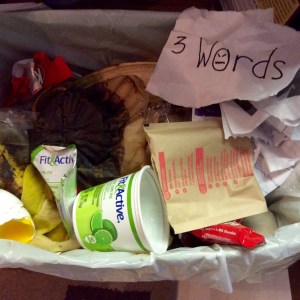
 “See, Mom.” Gabe said as he handed me his grammar sentences, “They’re not garbagy three-word sentences.”
“What’s that?” I asked.
“You know. Like you said before: ‘garbagy three-word sentences.’ These are definitely not that.”
I looked at his sentences. They were indeed lovely.
Gabe writes sentences every day for several subjects: spelling (when he gets the word wrong), vocabulary, or any time a concept needs to be reinforced. Single sentences don’t hurt when they’re dissected for grammar. Single sentences are bites off the writing proficiency elephant. I love them. Apparently that remark stuck with Gabe and has been rolling around his head as he does his school work. That word, garbagy. I made it up. I reserve the right to turn nouns into adjectives in my quest to inspire greatness. Sometimes I’m a Machiavellian. Sometimes I’m Machiavellianesque. Depends on the end I’m trying to justify.
Just what does a garbagy three-word sentence look like? Take the word vicissitude. We ran across that in history today. Our book was written in 1879, which explains why it contains word-gems like vicissitude. “Write a sentence with vicissitude,” I might say to Gabe, and I’d get something like this: “I hate vicissitudes,” which, while not an incorrect use of the word, is still a garbagy three-word sentence. And because I love language, I require that the writing submitted in single sentences be full of vicissitudes of rhythm and structure. There. That’s not a garbagy three-word sentence, either.
 KL Griffiths
I’m so glad you teach our kids! Love you.